If you’re dealing with loose, ill-fitting dentures or teeth that you have to keep patching or extracting, you know that something has to change. But you might not know where to even begin. With so many denture options out there, it can be difficult to weigh the pros and cons to settle on what’s best for you. You don’t have to do that research alone.
At West Wind Dental, we start by asking what you want your teeth to do for you. Maybe you want your denture to stay put, or you’re looking for something that feels more like natural teeth. Once we know what you’re trying to accomplish, we can find an option that makes sense for you.
Denture Options at a Glance
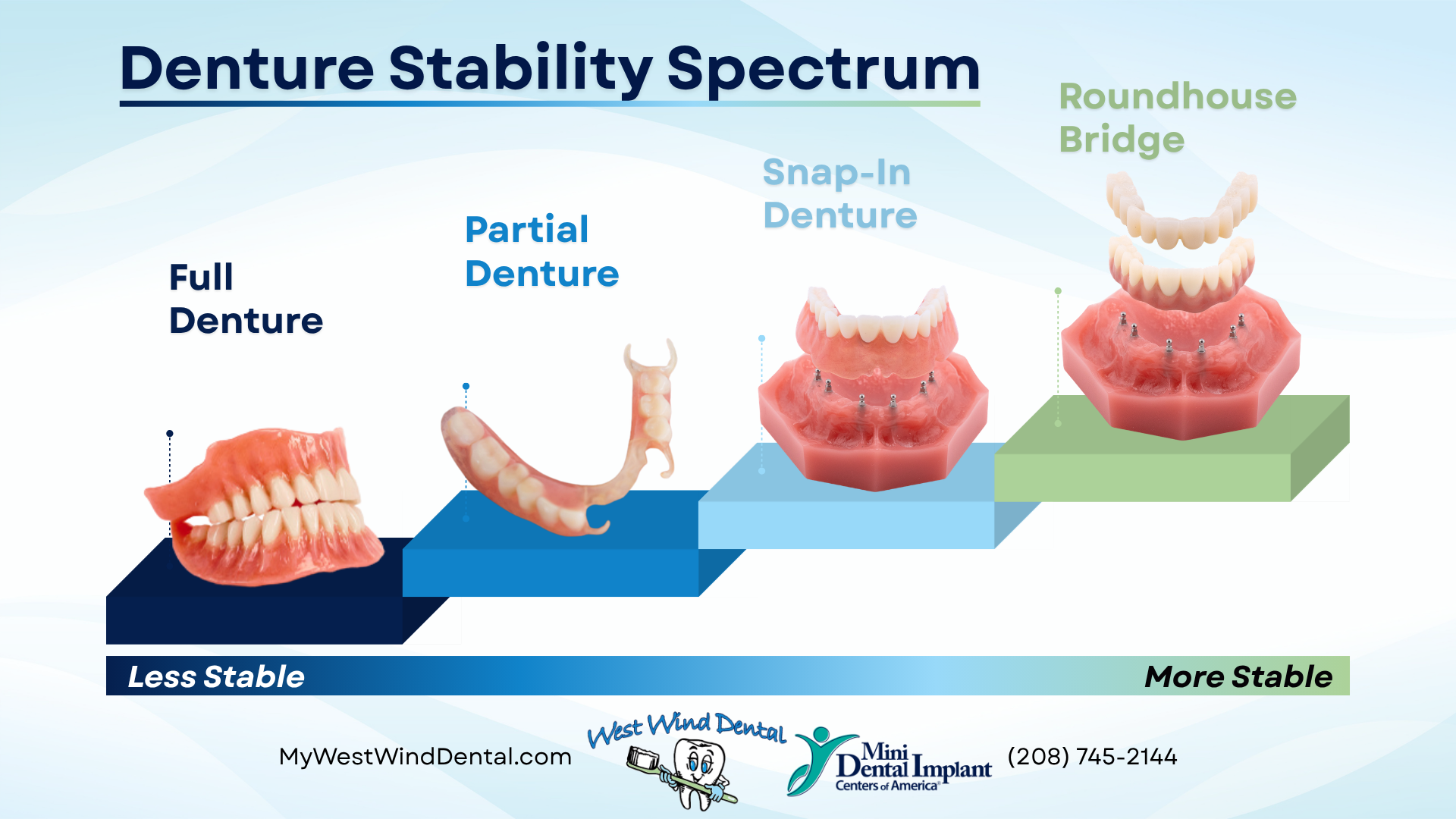
When most people think of dentures, they picture a removable plate that comes out at night. That’s a traditional denture, and it’s still a viable, affordable option for many patients. If you still have some healthy teeth, a partial denture can fill the spaces while using the teeth that remain for support. Both of these conventional denture options sit on the gum line and can be removed for cleaning and comfort.
From there, your options become more secure, thanks to dental implants. At our office, we use one-piece dental implants (particularly mini dental implants), which provide far more stability than any adhesive you may have used in the past.
Snap-in dentures use 4-6 mini dental implants anchored in your jawbone to hold your acrylic denture firmly in place throughout the day. You still remove them for cleaning, but they don’t shift or float like traditional dentures can. And if you already wear a traditional denture, you may not need a brand-new one. We can often retrofit your existing denture to snap onto implants, improving stability while saving you time and money.
Further along the implant denture spectrum are permanent denture solutions like the Fix-on-Six roundhouse bridge, which only Dr. Ellis will remove at your routine visits. These “semi-removable” porcelain restorations behave and look more like natural teeth. With 6-10 mini implants supporting this full-arch bridge, you can trust that your teeth won’t budge.
Now, if you’re looking for the best of the best, we also offer a permanent full-arch restoration. This ceramic roundhouse bridge is cemented onto 10-12 mini implants for even more support. It never comes out, so it functions and feels the most like real teeth. While it has the highest upfront cost, patients love the “set it and forget it” convenience this option offers. There’s also something to be said about the freedom you get with a denture alternative like this. Choosing a permanent roundhouse bridge lets you enjoy all your favorite foods and smile confidently without worrying about your teeth shifting or coming loose.
3 Questions To Narrow Down Your Decision
Finding the right denture solution may seem overwhelming. In our experience, three questions do most of the heavy lifting when it comes to narrowing down your choices before your free consultation.
1. How many teeth need to be replaced?
If you still have some healthy teeth doing their job, we want to work with what you have. That may mean fitting you for a partial denture or using implants to fill gaps. If most or all of the teeth on your upper or lower arch are missing or need to be extracted, then we start looking at full-arch options. It really comes down to what you have left, how much support we have to work with, and what you want your final result to be.
2. What level of stability are you looking for?
This one is personal. Think about what you actually want your teeth to do for you. Are you talking to people all day at work? Have you stopped eating steak, corn on the cob, or other foods because your denture moves around? Are you fine with taking your teeth out to clean them, or do you want something that stays put and becomes yours? The more stability and chewing ability you want, the more we start talking about what implants can do to support your teeth.
3. Are you thinking about cost now, or cost over time?
There’s nothing wrong with either approach. An acrylic denture is going to be the more economical option upfront, but acrylic wears out over time and typically needs to be replaced every seven to ten years. A ceramic restoration costs more initially, but it’s a much longer-term solution.
We look at what you want, what makes sense for your budget, and where you ultimately want to end up. Then we find the best way to get you there.
The Importance of a Denture Option Consultation
Every one of the questions above matters, but before we can get you started, we need to evaluate your gum and bone health to see which denture options make the most sense.
Dr. Ellis has been practicing dentistry for over 25 years and placing implants for about 18 years. Over that time, he’s seen plenty of patients who were told they didn’t have enough bone for implants. Mini dental implants really shine in those situations. Because they’re smaller in diameter, we can often place them in areas where there just isn’t enough bone for a larger traditional implant. For many patients, that opens the door to options they may have been told weren’t possible.
A free consultation and 3D cone beam scan let us see what we have to work with and show you what’s possible for your smile.
Learn the Best Denture Options for You: Book a Free Consult Today
You don’t need to have your denture options figured out before you walk through our door. That’s our job! We’ll help you sort through the options based on what you have to work with and what you want your teeth to do for you.
Maybe you still have some healthy teeth worth keeping. Maybe you need to replace an entire arch. Or maybe you’re just tired of dealing with a loose denture. No matter your situation, there are probably more options available than you realize.
When you visit West Wind Dental, we’ll help you find the denture solution that makes the most sense for you. If you’re in Eastern Idaho and are ready to explore your options, schedule a free consultation with Dr. Ellis.