If you’ve spent any time researching tooth replacement or denture alternatives, you’ve probably run across the term “All on X.” It may sound like the name of one particular treatment, but it’s really a broader way of describing a full arch of replacement teeth supported by dental implants. You may already be familiar with one version of the concept: All-on-4.
The “X” simply stands for the number of implants used to support the new teeth. That number can change, and it’s an important part of the conversation.
Four implants may be enough for one approach, while another may rely on six, eight, or more. At West Wind Dental, we think it’s worth looking beyond the name of the system and asking a practical question: how much support do you want under an entire arch of teeth? For Dr. Robert Ellis, that question is one of the most important considerations when planning a full arch case.
What All on X Means
With All on X, we replace an entire upper or lower arch of teeth and use implants underneath to hold and support the denture. Unlike a traditional denture that uses your mouth’s tissues for support, implants give the new teeth a more solid base. But how many implants are needed?
The “X” in All on X is a variable, not a specific number. All-on-4 is probably the best-known example, but we can place six or more implants to support a full arch restoration. How many we use depends on the treatment system, denture material, implant type, and the amount and quality of bone available.
Why the Number of Dental Implants Matters
Dr. Ellis has a background in construction, and that experience has influenced how he plans full arch implant cases. More support underneath a structure generally puts you in a better position. He applies the same thinking to an arch of replacement teeth.
His concern with a four-implant system is what happens if one of those four implants fails. When the entire restoration depends on four points of support, losing one leaves only three implants carrying the arch. In that situation, the whole case is compromised.
For that reason, Dr. Ellis would rather have six or eight implants supporting an arch when the patient’s bone allows for it. With additional implants in place, the restoration isn’t depending on just four points of support.
It’s a pretty practical philosophy, and one that makes sense given Dr. Ellis’s background: when you’re building something you want to last, having more support gives you a better foundation to build on.
Beyond All on X: Full Arch Options at West Wind Dental
Mini dental implants give Dr. Ellis more flexibility when he’s planning tooth replacement. Because they’re much smaller in diameter than traditional implants, he can often position them in areas of the bone that can’t accommodate a larger implant. Their smaller size also makes it possible to spread more implants across the arch, giving the new teeth more points of support instead of relying on just four.
That fits well with Dr. Ellis’s philosophy. If the bone allows him to place six, eight, or more implants under a full arch, he would rather have that additional support.
Additionally, many of the All on X systems patients hear about, like All-on-4, use traditional two-piece dental implants. These implants have two main components: the implant body placed in the jaw and a separate piece that connects the restoration to the implant. While these implants are still common in dental practices, they’re not always the best solution.
The mini implants we use are one-piece implants, meaning the implant and the portion that extends above the gums are a single unit. The design has been around for about 40 years, and Dr. Ellis believes its simplicity is one of its strengths.
For patients who want a full arch of replacement teeth supported by mini implants, West Wind Dental offers two primary options: Fix-on-Six® and a permanent roundhouse bridge.
Fix-on-Six®
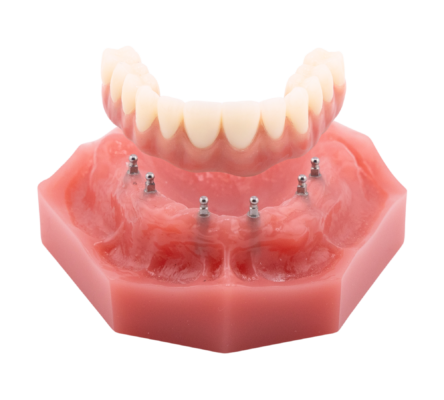 Fix-on-Six® uses about six mini dental implants to support a porcelain roundhouse bridge. Dr. Ellis considers six implants a good starting point when the patient has strong bone and each implant feels solid at placement.
But he isn’t committed to the number six just because it’s in the name. As he places the implants, he pays close attention to how firmly each one engages the bone. If one doesn’t have the stability he wants, he may place one or two additional implants to give the restoration more support. When he decides those extra implants are needed during placement, he places them at his cost.
Once the final bridge is in place, it stays put during your day-to-day life so you can eat confidently and speak clearly. You don’t take it out yourself. At routine visits, we can remove it for cleaning and then secure it again.
Permanent Roundhouse Bridge
A permanent roundhouse bridge takes the same idea a step further. Dr. Ellis typically uses 10 to 12 mini implants to support a full ceramic set of replacement teeth.
He then cements the bridge permanently to the implants, so it doesn’t come out at home or during routine checkups. You clean underneath it with a Waterpik and keep the area around the restoration clean with regular brushing.
Of all our full arch options, this one comes the closest to the look, feel, and function of a complete set of natural teeth.
Find Out How Much Support YOUR Smile Needs
The “X” in All on X may be just a number, but that number tells you how many implants are supporting an entire arch of teeth. For Dr. Ellis, choosing that number is an important part of building a restoration with enough support for the long haul.
Mini dental implants give him the flexibility to use more points of support when your bone allows for it, whether that means a Fix-on-Six® restoration or a permanent roundhouse bridge. If you’re considering full arch tooth replacement, schedule a free consultation today. Dr. Ellis can evaluate your bone and recommend the best option for your needs.