You left the consult feeling stuck. Maybe you were told there wasn’t enough bone for traditional implants, that a graft would come first, or that dentures were your only real option. If you’ve been searching for answers about not having enough bone for dental implants, you may be wondering whether a permanent solution is still at all possible. Patients hear that their jawbones can’t handle implants more often than you’d think, but that doesn’t mean they’re out of options.
At West Wind Dental, Dr. Ellis routinely treats patients with mini dental implants who were told they weren’t candidates at other offices.
[/ux_text] [/col] [/row]Quick answers if you’ve been told you don’t have enough bone for dental implants
- Does “not enough bone” always rule out implants? No. It often rules out traditional-sized implants without grafting, not every implant approach.
- Why do patients hear this in Eastern Idaho? Years of missing teeth or loose dentures can shrink the jawbone needed for larger implants.
- What’s different about mini dental implants? Their smaller diameter can often fit where traditional implants would need a graft first.
- Do you always need a bone graft first? Not with the approach used at West Wind Dental. Grafting can be unpredictable and delay treatment, and minis can often avoid it.
- Who is this especially helpful for? Long-time denture wearers and patients (often women) with very little bone who were told implants weren’t possible.
- What’s the next step? A free consultation with CBCT 3D imaging in Rigby so you get a clear yes, no, or better-path answer, not a guess from a 2D X-ray alone.
Why Patients Hear “You Don’t Have Enough Bone for Dental Implants”
When a tooth is missing, the jawbone in that spot no longer gets the stimulation it once did from chewing. Over time, that bone can shrink in height and width. Traditional dental implants are wider posts. They need enough bone to sit securely, the same way a heavy fence post needs solid ground.
That’s why so many patients hear a version of the same sentence: You don’t have enough bone for dental implants. En American Dental Association’s MouthHealthy overview of dental implants describes implants as titanium posts placed in the jaw to anchor replacement teeth, and healthy bone is part of what makes that foundation work. Bone grafting is commonly used when bone volume is too low for conventional implant placement, but full healing can take months. Plus, a bone graft doesn’t guarantee that you’ll be a candidate for conventional implants.
That doesn’t mean you’re stuck. It means the usual plan may not fit your bone. Mini dental implants are built for that exact situation, and West Wind Dental is a Mini Dental Implant Center of America.
What Traditional Implants Require, and Where Grafting Comes In
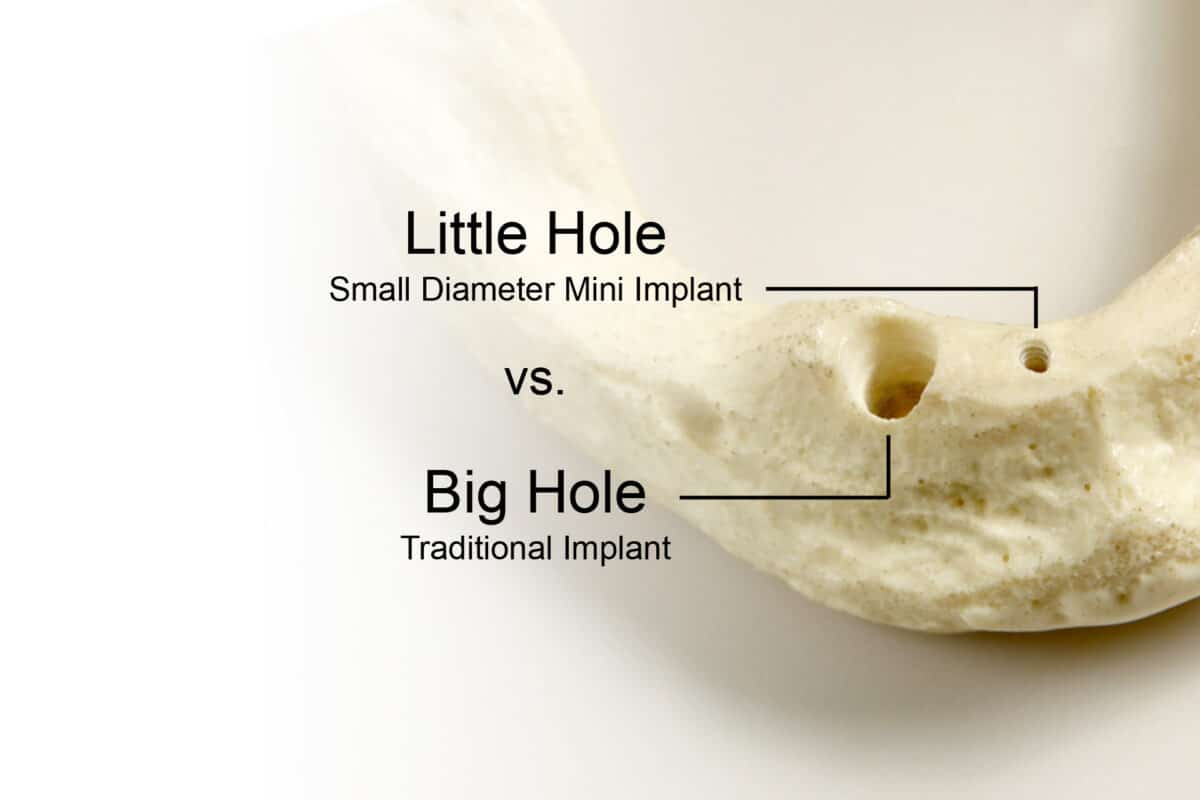
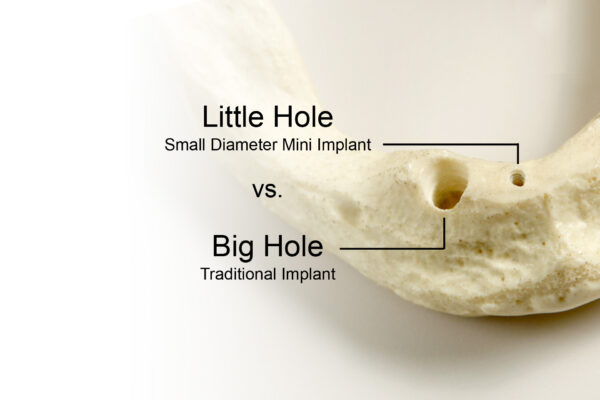 Traditional two-piece implants are designed for strength in bone that’s already there. When it isn’t, the common next step is bone grafting: rebuild the ridge, wait for healing, then place the implant later. For some patients, that path works. For others, it adds months, cost, and uncertainty.
That waiting period is one reason patients from Idaho Falls, Ammon, Rexburg, and across Eastern Idaho come to West Wind Dental for a second opinion, especially after being told implants weren’t possible without grafting first.
How Mini Dental Implants Expand Your Treatment Options
Miniimplantes dentales are roughly half the diameter of many traditional implants. Less diameter means less bone is required, and fewer situations where a graft stands between you and treatment.
In a video from our library, Dr. Robert Ellis explains:
“The mini dental implant, it really excels in areas where there is not enough bone. If you’ve ever been to a dentist who says you just do not have enough bone to place an implant, almost always we are able to place a mini dental implant because they have a smaller diameter. We can place them in areas where we can’t place a traditional implant without significant effort. And by that, I mean additional surgeries like bone graifting.
Bone graifting is a little hit and miss. Sometimes it works great, sometimes it doesn’t. It delays your treatment. It delays you getting a tooth. But the mini implant is FDA approved to be used exactly the way we’re using it. It’s gaining more and more acceptance all the time. Some of my best rewarding cases have been placing implants on patients, typically women, with very little bone, and we have changed their lives.”
Dr. Ellis’s approach to implant dentistry reflects a practical lesson from his previous career in construction. You choose a screw that suits the lumber, rather than forcing in one that’s too wide. Choosing between mini implants vs. traditional implants follows the same idea: match the tool to the bone, not the other way around.
One of Dr. Ellis’s very first cases was placing four miniimplantes for his mother to stabilize her lower denture. Since becoming a Mini Dental Implant Center of America, the practice has focused almost exclusively on this approach.
Who Mini Implants Help Most in Idaho Falls and Rigby
This conversation about not having enough bone for dental implants comes up again and again for:
- Patients told they need a bone graft before implants
- Long-time denture wearers whose ridges have flattened over the years
- People with loose dentures who are tired of adhesives and guesswork
- Adults missing one tooth or several who were told “traditional implants won’t work here”
- Patients (often women with very little bone) who left another office thinking implants were off the table
If that sounds like you, you’re the kind of patient Dr. Ellis is talking about when he says some of his most rewarding cases started with people who thought implants weren’t possible.
How West Wind Evaluates Bone (So You’re Not Guessing)
A flat 2D X-ray doesn’t always tell the whole story. At West Wind Dental, planning implants includes CBCT 3D imaging so Dr. Ellis can see bone height, width, density, nerves, and sinuses before recommending treatment.
As Dr. Ellis explains:
“CBCT is a cone beam technology that is like an MRI but without all the banging. It allows us to see the tooth in all three dimensions. It really helps us diagnose things that are just not visible on a two-dimensional X-ray.
I honestly could not practice today without one. It is fantastic in aiding us in doing the implants that we do.”
That scan, paired with a free consultation, helps us answer the real question: Do you have enough bone for mini or larger one-piece dental implants?
One-piece mini implants are simpler to place, easier on patients, and quicker to complete. They’re also generally associated with fewer complications than larger two-piece systems, which is part of why they work so well in limited-bone cases.
Three Questions Worth Asking After You’ve Been Told “No”
1. Was that “no” about traditional implants, or about every implant?
Those are different answers. Ask specifically whether smaller-diameter or mini implants were considered.
2. Was grafting presented as the only path forward?
Grafting can be the right call for some people. It isn’t the only tool in every toolbox. Ask what happens if you want to avoid or minimize grafting.
3. Did anyone map your bone in 3D?
A second opinion with CBCT imaging can change the picture, especially for lower front ridges and other areas where bone is naturally thinner. If you’ve already been turned away once, that second look is often the difference between giving up and getting a workable plan.
Ready for a Clear Answer About Your Bone and Your Options?
Hearing that you don’t have enough bone for dental implants can feel final. In Eastern Idaho, it often isn’t. As a Mini Dental Implant Center of America, West Wind Dental evaluates limited-bone cases every week and looks for the least invasive path to restore chewing, comfort, and confidence.
Take the dental implant quiz o programar una consulta gratuita with Dr. Robert Ellis in Rigby. West Wind Dental is located at 243 E Fremont Ave, Rigby, ID 83442, and we welcome patients from Idaho Falls and throughout Eastern Idaho.